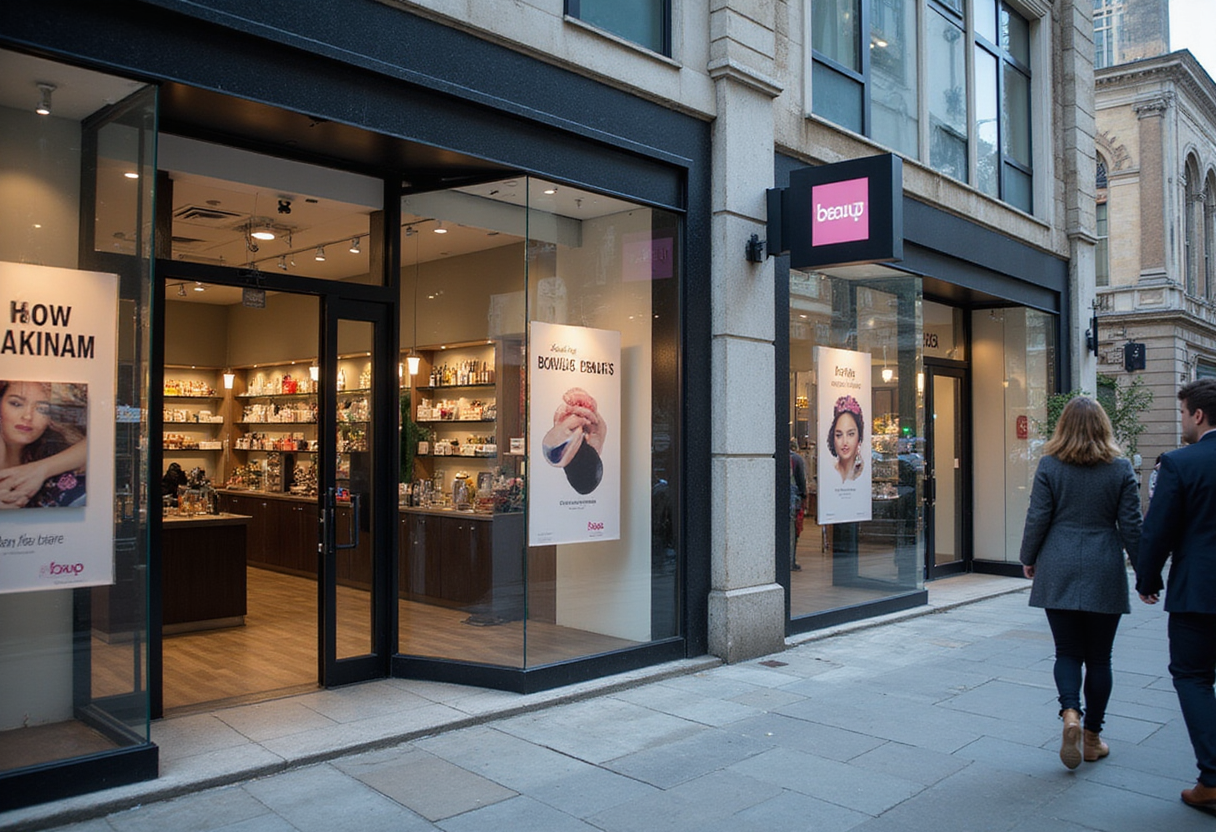
Salon market boom absorbing vacant UK high street space, report finds
UK beauty operators are absorbing vacant high street units as the salon market records a sustained boom, a report cited by Business Live finds, positioning personal services as a counter-cyclical retail category.
- Words
- James Calloway
- Photography
- AI-generated
- Filed
- Industry & Market
- Published
- Read
- 3 min read
Updated
The UK beauty sector is taking up vacant high street units at scale, according to a report cited by Business Live, as the salon market records what the publication describes as a sustained boom.
The headline finding — beauty businesses filling space left by closed retailers — signals a structural shift in the composition of British high streets, with hairdressing, barbering and beauty services increasingly the first option for landlords (commercial property owners) seeking tenants.
For salon owners, franchise groups and independent operators, the framing matters: it positions the personal services sector as a counter-cyclical (performing well when the broader retail market weakens) beneficiary of the redistribution of high street footfall (pedestrian customer traffic) away from goods-based retail.
What does the report's headline finding mean for trade readers?
The Business Live summary frames the salon market as an expansion category within UK commercial property. Beauty tenants typically work with smaller floor areas, accept shorter lease terms (rental contracts between tenant and landlord) and generate higher per-square-foot revenue than many comparison goods retailers — the three metrics that make them attractive to commercial property agents.
The report's public framing does not disclose specific figures for unit growth (net new openings minus closures), average lease lengths, or service revenue benchmarks. Salon professionals evaluating expansion should treat the headline as a directional indicator and await the underlying data set.
How does this fit the wider UK retail context?
The pattern — services replacing goods on the high street — echoes earlier UK research on convenience retail and banking branch contraction. Beauty operators have a documented capacity to absorb secondary high street units (locations outside primary retail cores) that grocery, pharmacy and clothing retailers have vacated since the contraction of the post-2020 retail cycle.
For the salon professional specifically, the implication has two dimensions:
- Demand: concentration of customer footfall around service destinations supports walk-in enquiry conversion
- Supply: more competitive premises options in second-tier retail locations, with the trade-off of potentially weaker pedestrian count
Where does this leave competing retail categories?
Beauty is not the only services category expanding on UK high streets. Coffee operators, takeaway food, and wellness concepts have all competed for the same vacated units in the past five years. The Business Live-cited report, however, frames the salon market as the leading beneficiary — a positioning that carries weight with commercial landlords when negotiating new leases.
For trade suppliers and product distributors, the implication is a customer base that is geographically broader than five years ago. Salon openings in secondary locations expand the wholesale and distribution catchment beyond traditional prime high street clusters, requiring sales teams to revisit route planning.
What should salon owners watch next?
If the reported boom sustains through 2026, expect salon groups to accelerate rollout in towns where pharmacy, banking and clothing tenancies (leasehold occupancies) have rolled back. The two figures to monitor in subsequent releases are net unit growth and average rent per square foot — both will determine whether the trend represents genuine sector expansion or simply the replacement of closed competitors. Trade buyers should also track whether the report's underlying data differentiates by hair type and texture service mix, given that texture-specific salons (curly, coily, protective style specialists) have shown distinct property-acquisition patterns in prior UK commercial property surveys.
Source — Source: Google News: Salon business
More from James Calloway
Show full bio
Staff writer covering money, funding and market shifts around Professional cutting, styling and color technique at Shear Daily.
27 articles